Gas Tokens, Native Tokens, and Why You're Getting Stuck at the Bridge
You've done everything right. You bridged your USDC to a shiny new chain, watched the confirmation come through, and opened your wallet to admire your new multi-chain life.
And now you're stuck. Not "the bridge is down" stuck. Stuck in the quieter, dumber way: you have money, and you cannot spend a cent of it, because you don't have the one token the network will actually accept as payment for doing anything at all.
Welcome to the gas token problem. It's not a bug, and it's not really even a bridge issue - it's a side effect of how blockchains charge rent. Once you see how the pieces fit together, the "stuck at the bridge" moment stops being a mystery and starts being something you can see coming from a mile away.
First, what is a native token?
Every blockchain has one currency it insists on for its own upkeep. Ethereum wants ETH. Gnosis Chain wants xDAI. Solana wants SOL. This is the network's native token - the asset that pays for block space, and the only thing validators or sequencers will accept as a fee, no matter what else you're holding.
Layer 2s inherit this logic even when it seems like it shouldn't apply to them. Arbitrum, Optimism, and Base all use ETH as their native token too - but it's their ETH, sitting in their ledger, not a shared pool with Ethereum mainnet. Having ETH on Ethereum doesn't give you a drop of it on Base. They just happen to share a ticker.
Native, gas, and wrapped: three words doing the same job (mostly)
This is where most of the confusion actually lives, so it's worth being precise:
- Native token - the asset baked into the chain's core protocol as the fee currency. This is a design choice made at genesis.
- Gas token - informal shorthand for "whatever token you're using to pay a given transaction's fee." Ninety-nine times out of a hundred, that's the native token. It's the same thing wearing a more casual name.
- Wrapped token - an ERC-20-flavoured stand-in for a native token, created purely so the native asset can play nicely with smart contracts. WETH is wrapped ETH. wxDAI is wrapped xDAI. Wrapping is a one-way-and-back conversion at a flat 1:1 rate - you're not gaining or losing anything, just changing the token's shape so contracts can move it.
That third one trips people up because it's easy to confuse with a fourth, unrelated thing: a bridged representation of an asset from another chain entirely - like USDC.e on a chain that isn't USDC's home turf. That's not a wrapped native token. It's an IOU for an asset that lives somewhere else. Different problem, different risk profile, same instinct to squint at your wallet and ask "wait, which one of these is real?"
Most chains agree on their toll-taker. Not all of them.
Here's the part that makes this genuinely tricky rather than just mildly annoying: there's no universal rule for which token a chain will accept. You have to know each one individually.
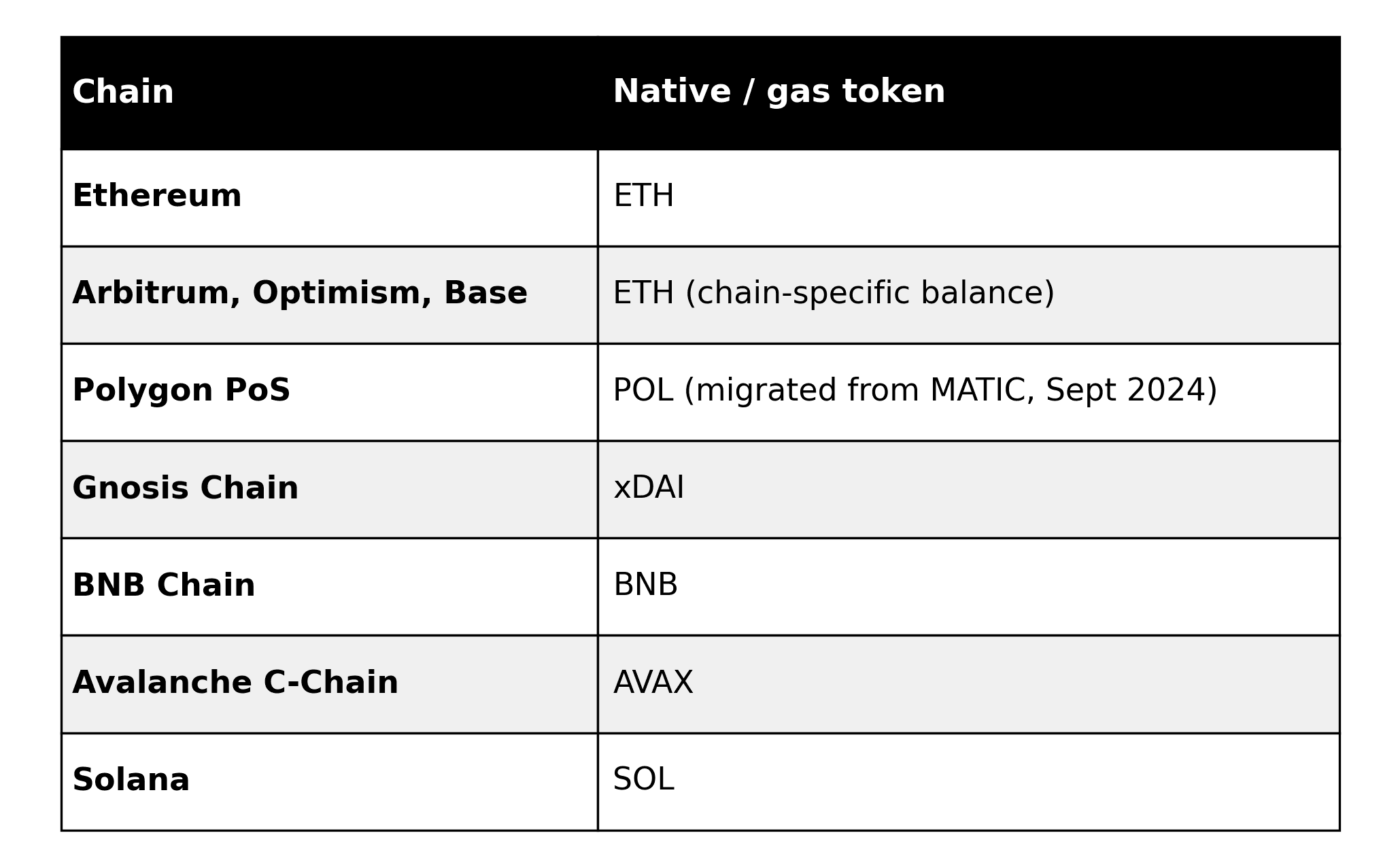
And then there are the exceptions that prove the rule is optional. Some OP Stack chains use a "custom gas token" feature to swap ETH out entirely - Fraxtal, for instance, runs on FRAX instead. If you're not paying attention when you bridge somewhere new, you can end up holding exactly the wrong assumption about what that network wants from you.
The moment you actually get stuck
Picture bridging 2,000 USDC from Arbitrum to a newer L2 you've never used before, to catch a yield opportunity you read about an hour ago. The bridge does its job: the USDC shows up, right on schedule.
Now try to do literally anything with it - swap it, approve it, send it - and your wallet stalls out asking for a fee in the chain's native token. Which you don't have. Because the bridge moved the asset you wanted, not the asset you'd need to use it. Your funds aren't lost. They're just sitting behind a toll booth, and you're the one person in line without correct change, on a road where nobody accepts anything else.
This is why "gas tokens" and "getting stuck at the bridge" are really the same conversation. The bridge did exactly what it promised. The gap is that arriving with value and arriving with the ability to spend that value are two separate events, and nothing about a standard bridge transfer guarantees both happen together.
The workarounds people reach for (and why they're patches, not fixes)
None of this is news to anyone who's spent real time bridging around, which is why a small folk wisdom has built up:
- Withdraw straight from an exchange to the destination chain in its native token, so you land with gas already in hand. Works, if you planned ahead and don't mind an extra hop through a centralized platform.
- Keep a standing float of gas on every chain you touch. Reasonable in theory, mildly ridiculous in practice once you're active on six or seven networks. It's asset management, but for the privilege of starting your asset management.
- Testnet-style faucets. Real on testnets, essentially non-existent for mainnet value - nobody's handing out free ETH on Base.
- "Gas drop" add-ons some bridges bundle in, quietly including a small amount of native gas alongside your transfer. Helpful, but it's a feature of that specific bridge, not something you can count on everywhere.
Every one of these is a way of remembering to solve the problem yourself, in advance, correctly, every single time. Which is a lot to ask of anyone who just wants to chase a yield opportunity before it disappears.
The actual fix: stop making gas your problem
The more durable answer isn't a better checklist - it's removing the step entirely. This is what "gas abstraction" means in practice, and it's shown up in a couple of forms:
Account abstraction (ERC-4337) introduced the paymaster: a contract that can front your gas fee, either sponsoring it outright or accepting payment in an ERC-20 token - including the very token you're trying to move - while quietly settling the actual fee in native currency behind the scenes. You never touch the native token at all.
Intent-based execution solves the same problem from a different angle. Instead of you constructing and paying for a transaction, you sign an intent - "I have this, I want that" - and a solver competes to fill it, fronting whatever gas is required along the way. CoW Protocol works this way: solvers execute trades on users' behalf and are compensated for settling batches, and fees are taken from the sell token itself rather than requiring you to hold the network's native currency up front.
When CoW Swap handles a cross-chain trade, that same logic extends across the bridge leg too - the solver network sources the route and fronts execution, so you're not left holding an asset on a new chain with no way to move it.
None of this is a workaround stacked on a workaround. It's a structural fix to the actual problem: gas tokens exist because someone has to pay the chain's toll, and there's no rule saying that someone has to be you, scrambling, after the fact, on a chain you've never used before.
The short version
- Native token = the chain's required fee currency, decided at genesis.
- Gas token = casual name for whatever's paying the fee right now - usually the native token.
- Wrapped token = an ERC-20 costume for a native token, not a different asset, not a bridge IOU.
- Bridges move the asset you asked for. They don't automatically hand you the toll money for the road you just landed on.
- The fix that actually holds up is one where you stop needing destination-chain gas in the first place.