The Difference Between a DEX Aggregator and a Bridge Aggregator (And Why You Need Both)
TL;DR
-
A DEX aggregator solves one problem: finding the best price for a trade within a single blockchain.
-
A bridge aggregator solves a different problem: finding the best route to move an asset between blockchains.
-
They look alike - both compare options and hide complexity - but they run on different infrastructure, with different risks and different failure modes.
-
Using only one leaves a gap. A great DEX aggregator can't get your tokens to another chain. A great bridge aggregator can't guarantee you a good price once they land.
-
CoW Swap runs both jobs in one flow - DEX aggregation via solver competition, bridge aggregation via Across, Bungee, and NEAR Intents - bundled into a single signed intent.
"Aggregator" is one of those DeFi words that gets said constantly and defined rarely. Ask someone what a DEX aggregator does and what a bridge aggregator does, and there's a decent chance you'll get the same answer twice - something like "it finds you the best deal." True. But it’s not the whole story.
A DEX aggregator and a bridge aggregator aren't two flavors of the same tool. They're two different tools, solving two different problems, built on two entirely different pieces of infrastructure. One lives entirely within a single blockchain. The other exists specifically to get you off it.
Mix them up, and you end up shopping for the wrong solution to whatever's actually annoying you. Understand the difference, and it becomes obvious why serious cross-chain trading needs both, working together - not as a nice-to-have, but as the actual minimum bar. This article explains them both, and how you can benefit from both.
What a DEX aggregator does
Think of a DEX aggregator as a price-comparison tool for a single blockchain. Liquidity for any given token pair - ETH/USDC, say - isn't sitting in one place. It's fragmented across dozens of decentralized exchanges: Uniswap pools, Curve pools, Balancer pools, private market makers, all on the same chain, all with their own AMM math ticking away independently. Checking each one by hand, working out which offers the least price impact for your trade size, takes a human longer than the market takes to move.
A DEX aggregator automates that search. It scans the available liquidity sources, compares quotes, and - in more advanced systems like CoW Protocol's batch auctions - lets professional solvers compete off-chain to fill your order, including private liquidity a simple router might never see. The trade still happens on the chain you started on. Nothing crosses a network boundary. The job is entirely: find the best price, here, now.
(For the full mechanics - smart order routing, solver competition, the shift from routers to intents - see What is a DEX aggregator? and What is a DeFi aggregator?)
What a bridge aggregator does
A bridge aggregator solves a completely different problem, starting from a completely different premise: your tokens are on the wrong chain, and no DEX, however smart, can fix that. Uniswap doesn't have an opinion on your assets sitting on Arbitrum when you need them on Base. That's not what it does.
Getting assets across chains means using a bridge - infrastructure that locks, burns, or messages a token's value from one network to another. And just like DEX liquidity, bridge infrastructure is fragmented: dozens of protocols exist, each with different fees, speeds, security models, and chain coverage.
A bridge aggregator does for bridges what a DEX aggregator does for exchanges: scans the available routes, compares them on cost, speed, and reliability, and executes the best one - sometimes splitting large transfers across multiple bridges, sometimes finding multi-hop paths when no direct route exists. We've gone deep on the mechanics in What is a bridge aggregator?
Where they look alike - and where that stops
On the surface, the two jobs sound like the same job with a find-and-replace: swap "exchange" for "bridge" and you're done. That's why the terms get used interchangeably so often. The resemblance is skin-deep, though. Underneath, they're solving structurally different problems.
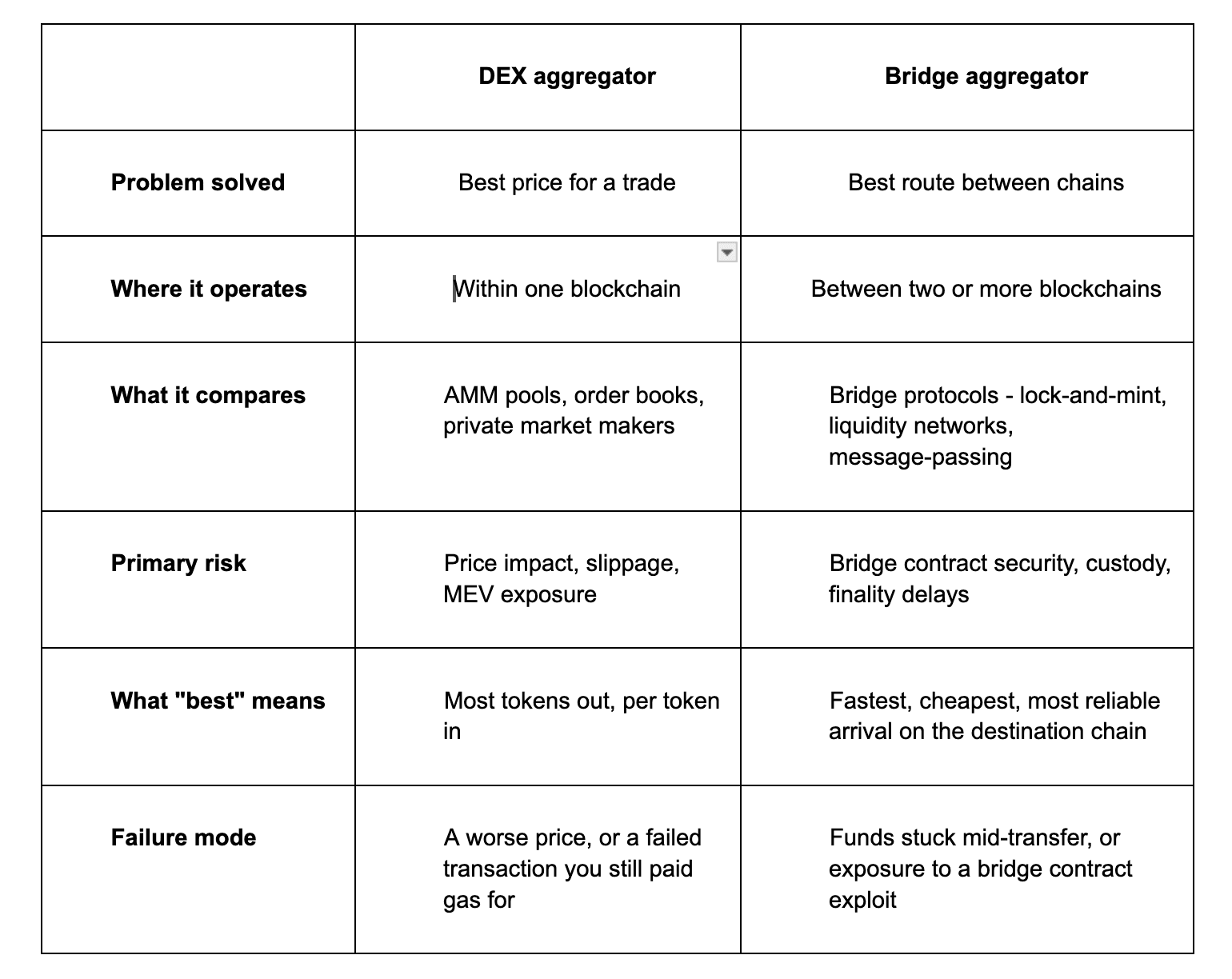
That risk-and-failure-mode row is the one that matters most. A bad DEX route costs you basis points. A bad bridge route can strand your funds between two chains for hours, or expose them to a hack in a bridge contract you never chose to trust directly. Cross-chain bridges carry a genuinely different category of risk to "I got a slightly worse swap price" - worth reading up on in what to check before you use one.
Why you need both
Here's where it gets concrete. Say you're holding USDC on Arbitrum, and you've spotted an opportunity that needs ETH on Base.
With only a DEX aggregator, you're stuck. It'll get you a great price for USDC → ETH - on Arbitrum. Your ETH still isn't on Base. You'd need to bridge it yourself, manually, in a separate step, on a separate app, hoping you picked a bridge that wasn't this week's headline exploit.
With only a bridge aggregator, you can get your USDC moved over to Base efficiently - but you land holding USDC, not ETH. You still need a separate swap, at whatever price happens to be available in that moment, with nothing competing on your behalf to improve it.
Either way, you're back to the three-steps, three-gas-fees, three-chances-to-mess-it-up experience that makes cross-chain trading feel like a part-time job: open one app to bridge, wait, pay gas, open another app to swap, wait again, pay more gas - hoping prices haven't moved against you in between. We've broken that specific friction down before inUnderstanding cross-chain swaps.
A DEX aggregator alone gets you a good deal on the wrong chain. A bridge aggregator alone gets you to the right chain holding the wrong asset. You need both jobs done - and ideally, done together, in one motion, rather than stitched together by hand.
How CoW Swap does both, in one flow
CoW Swap evolved from a DEX aggregator into a DEX and bridge aggregator, rather than staying in its lane.
When you make a cross-chain swap on CoW Swap, both jobs run inside a single intent:
-
The DEX aggregation leg - CoW Protocol solvers compete to fill your swap, the same mechanism that's always powered CoW Swap on a single chain.
-
The bridge aggregation leg - CoW Swap compares routes across integrated bridge providers, currently Across, Bungee, and NEAR Intents, to find a path to your destination chain.
-
One signature, bundled together - both legs sit inside a single transaction. If either leg fails, the whole thing reverts, rather than leaving you holding half a trade on the wrong chain.
You still get the benefit of solver competition on the swap side and route comparison on the bridge side - you just aren't the one manually stitching the two together, tab by tab, gas fee by gas fee. The full mechanics of that one-flow model are covered in From DEX Aggregator to Bridge Aggregator: CoW Swap's One-Flow Revolution.
The bottom line
A DEX aggregator and a bridge aggregator aren't competing products, and they're not the same product wearing a different hat. They're two layers of the same multi-chain stack, solving two different problems with two different risk profiles. Used alone, either one leaves you finishing the job by hand. Used together, they cover the whole trip - from the price you get, to the chain you land on.
👉 Try a cross-chain swap on CoW Swap
Further reading
-
From DEX Aggregator to Bridge Aggregator: CoW Swap's One-Flow Revolution
-
What are the current best practices for using cross-chain bridges