The Stablecoin Bridging Checklist: Six Things to Check Before You Move a Dollar Across Chains
You want to move 5,000 USDC from Arbitrum to Base. Simple, right? You open a bridge, type in the amount, hit confirm. Twenty minutes later you're staring at a wallet balance that's a bit smaller than you expected, and no single line item explains why.
That gap between "what the bridge quoted" and "what actually landed" is rarely one big fee. It's usually five or six small ones stacking on top of each other - and each one is checkable before you send, not something you have to accept after the fact. Here's what to look for when bridging stablecoins.
1. Work out your real cost equation, not just "the bridge fee"
Most people look at the number a bridge shows them - say, 6 basis points - and stop there. But that's one slice of a longer chain, which typically looks something like this:
Origin swap fee (if any) + origin gas + bridge/protocol fee + relayer or LP fee + destination gas + destination swap fee (if any)
Let's look at that in action. On a $10,000 transfer, a 0.05% swap fee on the way in is $5 before you've touched the bridge. Gas on a congested L1 can be another $5-50 depending on timing. None of these show up in the headline "bridge fee" - they show up in your final balance. Checking the total, not the advertised toll, is step one.
2. Ask whether you need to swap to a stablecoin at all before bridging
There's a long-standing habit in DeFi of converting to USDC "to make the bridge cheaper," on the logic that stablecoins have the deepest liquidity. Often true - but that conversion is itself a transaction with its own fee and price impact, paid_before_ the bridge even starts. If the swap costs more than the bridge fee it was supposed to save, the shortcut has failed. Worth running the numbers both ways to ensure that assumption is true.
3. Know which rail actually applies to your stablecoin
Varies by integration
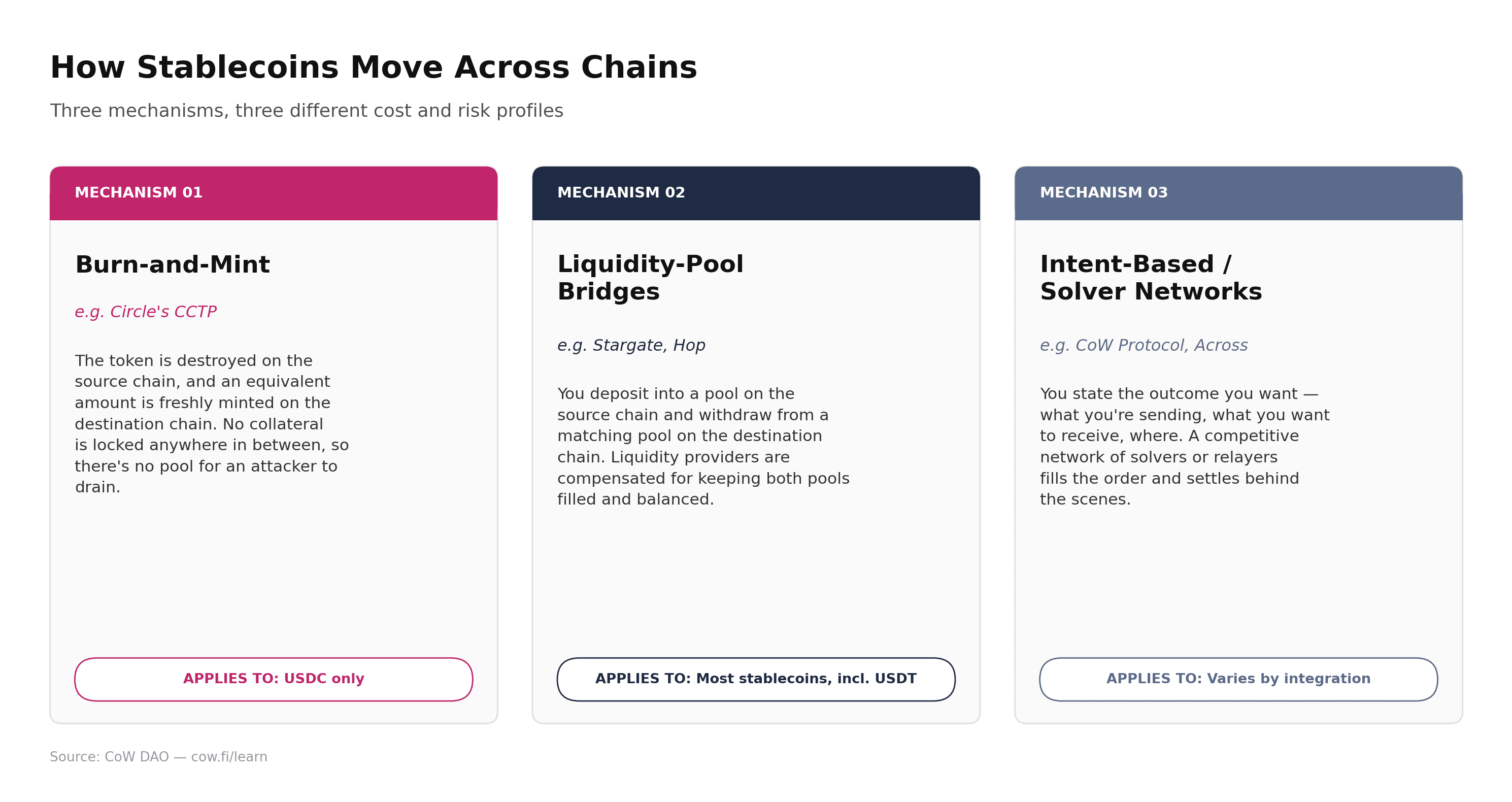
USDC-specific rails like CCTP don't help you if you're moving USDT - that's a different mechanism with different fee and timing characteristics. Confirm which rail you're actually on before comparing costs, since comparing a burn-and-mint quote to a liquidity-pool quote is comparing two different things.
4. Check gas on both ends - not just the chain you're leaving
This is the one that catches people out after the fact rather than before: you land on the destination chain holding stablecoins and nothing else, and there's no native gas token to do anything with them. You can't even swap your way out of it, because that swap itself needs gas. Before bridging, confirm you'll have enough of the destination chain's native token to actually use what arrives - or that your route handles this for you (some intent-based routes deduct gas needs from the transferred asset itself, so you land ready to use it).
5. Watch for native vs. bridged versions of the same ticker
USDC on Arbitrum isn't automatically the same asset as USDC on Ethereum. Circle-issued "native" USDC and legacy "bridged" versions like USDC.e can both show up in a wallet labeled similarly, but they aren't interchangeable everywhere - some protocols and some CEX deposit flows only accept the native version. Landing with the wrong variant means a second swap, a second fee, and in some cases funds that are difficult to recover if sent to the wrong contract. Worth a 30-second check against Circle's own contract address list before you assume a "USDC" balance is fungible with the USDC you started with.
6. Decide what you're actually optimizing for: cost, speed, or exposure
These trade off against each other, and the "right" answer depends on the transfer, not a universal rule:
- Cost-sensitive, not time-sensitive - a burn-and-mint transfer with standard (non-expedited) finality typically avoids liquidity-pool fees entirely, at the cost of waiting longer for confirmation.
- Time-sensitive - intent-based and liquidity-pool routes settle faster because solvers or LPs front the capital, but that speed is priced in.
- Security-conscious, large transfer - this is where it's worth remembering that bridges, as a category, have been the single largest attack surface in DeFi. Academic analysis of 49 cross-chain bridge incidents between mid-2021 and September 2024 puts cumulative losses at roughly $4.3 billion (Wu et al., ACM Web Conference 2025), and a separate 2025 review of 34 incidents found funds were typically moved within about two hours of the exploit - often before it was even publicly disclosed (Global Ledger, 2025). For large or repeated transfers, checking a bridge's audit history and validator model matters at least as much as its fee.
Where this leaves you
None of these checks are particularly groundbreaking - they're closer to reading the label before you buy something than to advanced DeFi strategy. The reason they matter is that "the bridge fee" is only ever one line of a longer receipt, and most of the other lines are visible in advance if you look.
If manually checking all six feels like a lot of tab-juggling for a routine transfer, that's the exact problem solver competition and intent-based routing are designed to absorb: on CoW Swap, a cross-chain trade is expressed as a single intent - what you're sending, what you want to receive, where - and the underlying CoW Protocol solver auction handles route selection, while the same MEV-protection mechanism that covers single-chain trades extends to the cross-chain flow. You can still check the route it picked; you just don't have to build the checklist yourself every time.
Further Reading
- Gas Tokens, Native Tokens, and Why You're Getting Stuck at the Bridge
- Wrapped Tokens vs. Native Bridging: What's the Difference, and Which Is Safer?
- Cross-Chain MEV: How Bots Extract Value When You Move Between Chains
- How Long Should a Bridge Transfer Take?
- The Difference Between a DEX Aggregator and a Bridge Aggregator (And Why You Need Both)