TWAP vs. Limit Orders: Which Should You Use and When?
TL;DR
- Limit orders let you name your price and wait. They execute only at your limit price or better, whenever the market gets there (or they expire).
- TWAP orders split one large trade into smaller equal parts, executed on a schedule, to avoid moving the market with a single big trade.
- The twist: a TWAP order is basically a string of mini limit orders on a timer. Same DNA, different job.
- Use a limit order when you care about price and are fine waiting an unknown amount of time.
- Use TWAP when you care about price impact - usually because your trade is big enough to move the market if you dumped it in all at once.
- Both run through CoW Protocol's batch auctions, so both come with MEV protection, gasless order management, and surplus capture - you're not trading away any of that by picking one over the other.
If you've spent any time in the CoW Swap "Advanced" tab, you've probably had this exact moment of hesitation: Limit or TWAP? They both sound like "smarter" ways to trade than a plain swap, but they solve different problems. Let's break down what each one is actually doing under the hood, and when to reach for which.
Quick refresher: what's a limit order?
A limit order is an instruction to buy or sell at a specific price or better, up until it expires. You're not saying "trade now" - you're saying "trade when the price is right, however long that takes."
On CoW Swap, limit orders come with a few mechanics worth knowing:
- Partially fillable by default. Your order can fill in chunks as liquidity becomes available at your price, rather than requiring the entire order to fill in one shot. This usually means faster completion than an all-or-nothing order.
- No separate fee. CoW Protocol covers network fees by waiting for a price slightly better than your limit price - which is also why your order might not fill the instant the spot price technically crosses your line.
- Gasless management. Placing, editing, and cancelling limit orders off-chain is free. (On-chain cancellation is available too, but costs gas - useful if you want a guaranteed, immediate cancel.)
We've covered the mechanics in full in Limit Orders Explained and the walkthrough in How to Use Limit Orders on CoW Swap, so we won't re-tread that ground here - just the parts that matter for this comparison.
Quick refresher: what's a TWAP order?
TWAP stands for Time-Weighted Average Price. Instead of placing one order, you split a large trade into equal parts and space them out over a set duration - say, six parts over three hours instead of one lump-sum trade. The goal is to land close to the average market price over that window, rather than whatever the price happens to be the second you hit "swap."
The parts you set:
- Number of parts - how many pieces your order is split into
- Total duration - how long the whole thing takes to execute
- Price Protection - an optional guardrail that pauses execution if the market moves against you by more than a percentage you set
One requirement to flag up front: TWAP orders currently need a Safe wallet with an upgraded fallback handler, since they run on CoW Protocol's Composable order framework. Regular swaps and limit orders don't have that requirement. We go deep on setup in Why TWAP? The Perks of Time-Weighted Average Price and How to use CoW Swap's TWAP orders via Safe Wallet.
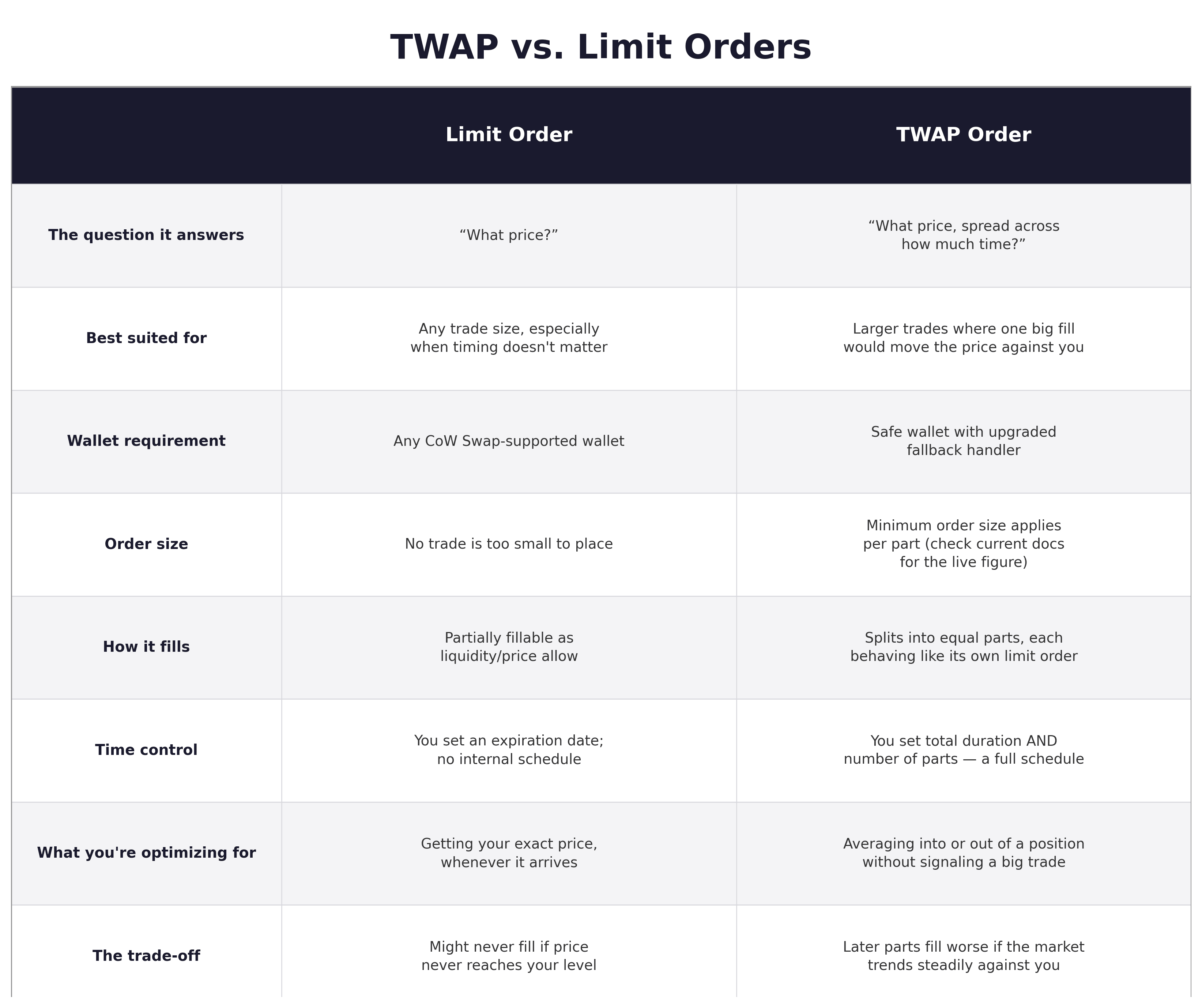
The side-by-side
The connection most people miss
Another way to think of the difference between limit and TWAP orders: a TWAP order isn't a separate species from a limit order - it's a_sequence_ of them. Each part of a TWAP trade executes as its own small limit order at fixed intervals. TWAP is really "limit order strategy, automated and scheduled."
That reframes the decision nicely. You're not choosing between two unrelated tools. You're choosing between:
- One limit order - I want this price, I'll wait for it.
- Many small limit orders on autopilot - I want to trade a large amount without my own order size becoming the thing that moves the price against me.
When to reach for a limit order
- You have a specific entry or exit price in mind (buying a dip, taking profit at a target) and you're comfortable waiting.
- Your trade size is small-to-moderate relative to the pool's liquidity - a single fill won't meaningfully move the market.
- You want to "set and forget" a price target without babysitting the market.
- You don't have a Safe wallet set up and don't want to make one just to place this trade.
When to reach for TWAP
- You're moving a large amount and a single trade would create real price impact.
- You're implementing a DCA-style strategy - buying or selling gradually rather than all at once. (More on that in Understanding Dollar Cost Averaging in Crypto.)
- You want to avoid signaling a big trade to the market - a large single order is a lot easier to spot (and front-run) than several smaller ones spread over time.
- You'd rather smooth out short-term volatility than bet on hitting one specific price.
What they have in common
Wherever you land, you're not giving anything up by choosing one order type over the other - both run through the same CoW Protocol machinery:
- MEV protection, via delegated trade execution, Coincidence of Wants matching, and uniform clearing prices within batch auctions (see How CoW Swap solves the MEV problem)
- Surplus capture - if solvers find you a better price than quoted, that improvement comes back to you, not the protocol
- Gasless order placement and cancellation (off-chain), so testing the waters costs nothing
- No fees for failed transactions
The cheat sheet
If you only remember one thing: limit orders optimize for price, TWAP orders optimize for size. Small trade, specific price target, willing to wait → limit order. Large trade, worried about moving the market yourself → TWAP. And if you're not sure your trade even qualifies as "large" in the first place, that's worth a gut check before reaching for TWAP's extra setup steps.
Further reading
- When to Swap and when to TWAP - the companion comparison, for when you're deciding between a plain swap and TWAP instead
- Limit Orders Explained
- How to Use Limit Orders on CoW Swap
- CoW Swap Improves the Limit Order Experience with Partially Fillable Limit Orders
- Why TWAP? The Perks of Time-Weighted Average Price
- Getting to Grips with Time-Weighted Average Price (TWAP) orders
- Understanding Dollar Cost Averaging in Crypto
- Introducing the Programmatic Order Framework, from CoW Protocol